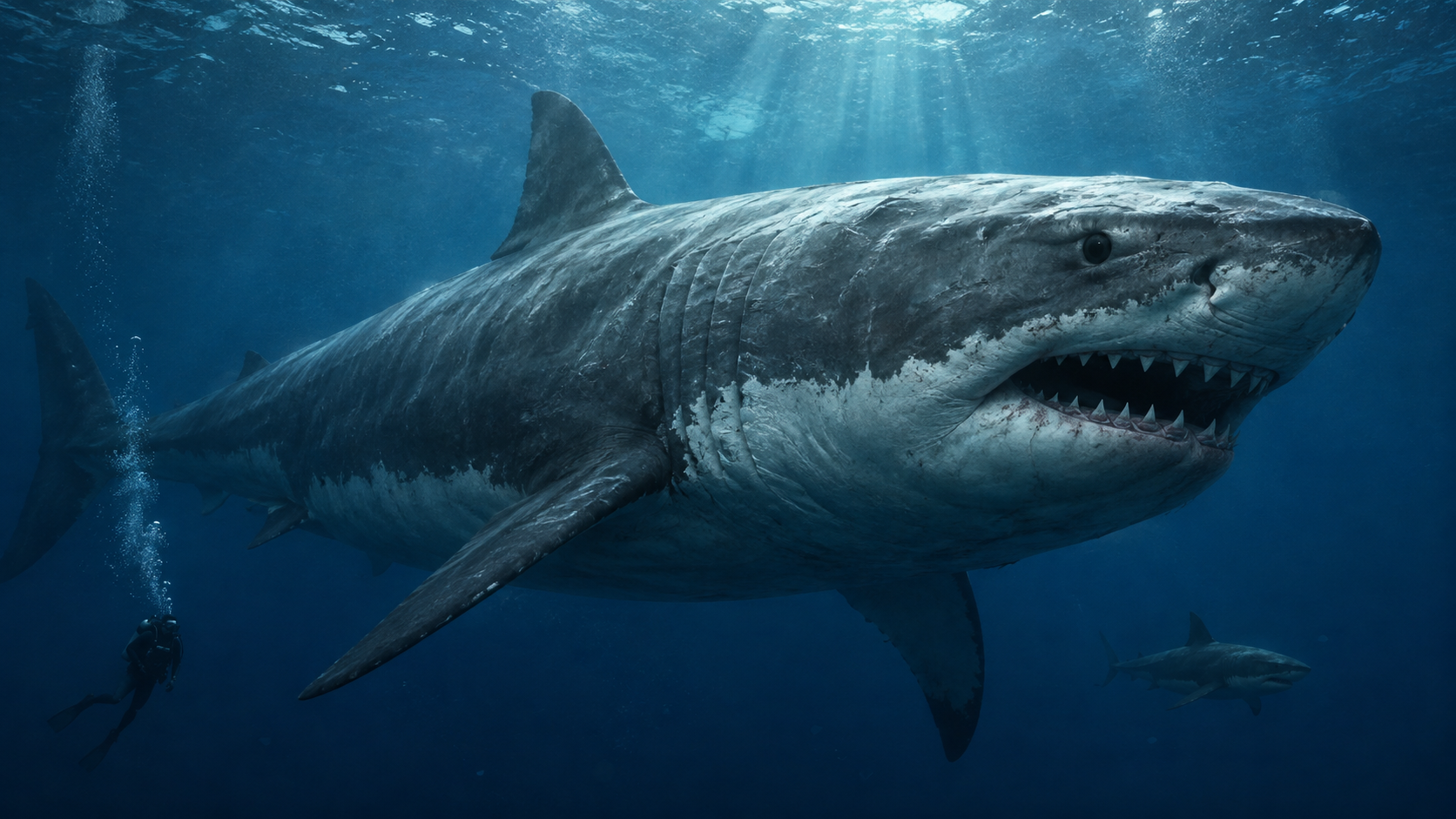
Megalodon is reconstructed mostly from teeth and vertebrae. ScaleCheck uses a conservative 18 m display length rather than treating the largest proposed upper bounds as settled fact.
Length
18 m conservative display estimate
Height
roughly 4.5 m through the body
Mass
about 50 tonnes in the ScaleCheck reconstruction
When
Miocene-Pliocene - about 23-3.6 million years ago
Conceptual reconstruction of Megalodon swimming in open water
All bars share one linear metre scale. Human height and animal body length use different orientations, noted on each detail page.
Interactive true-scale view
Megalodon beside a 1.7 m human
The shared ground plane keeps 18 m and the human reference on one metre scale. Detailed models load progressively; labeled wireframes preserve scale where a model is pending.
Preparing the true-scale scene...
Drag to orbit · Scroll to zoom
Megalodon18 mDetailed 3D model
Human1.7 mDetailed 3D model
Full 3D exhibit Continue into the ranked gallery to inspect the model, camera angles and surrounding giants.
Eighteen metres is about 10.6 reference-human heights and comfortably longer than a standard city bus. The widest part of the body would tower over a standing person.
More than one number
Length, height and body mass
It is shorter than the 33 m blue whale but far more massive than most modern sharks. Compared with a 13 m Mosasaurus, the displayed shark gains about five metres.
Display length
18 m
Display height
4.5 m
Display mass
50 t
Evidence boundary
How certain is this size?
Shark skeletons are mostly cartilage, so complete bodies do not fossilize. Researchers scale from teeth, vertebrae and living analogues, producing a broad range of estimates.
Why compare it
The question this animal answers
Megalodon is an ideal fossil-estimation case study: a compelling 3D reconstruction can be useful while still showing which dimensions are inferred rather than observed.