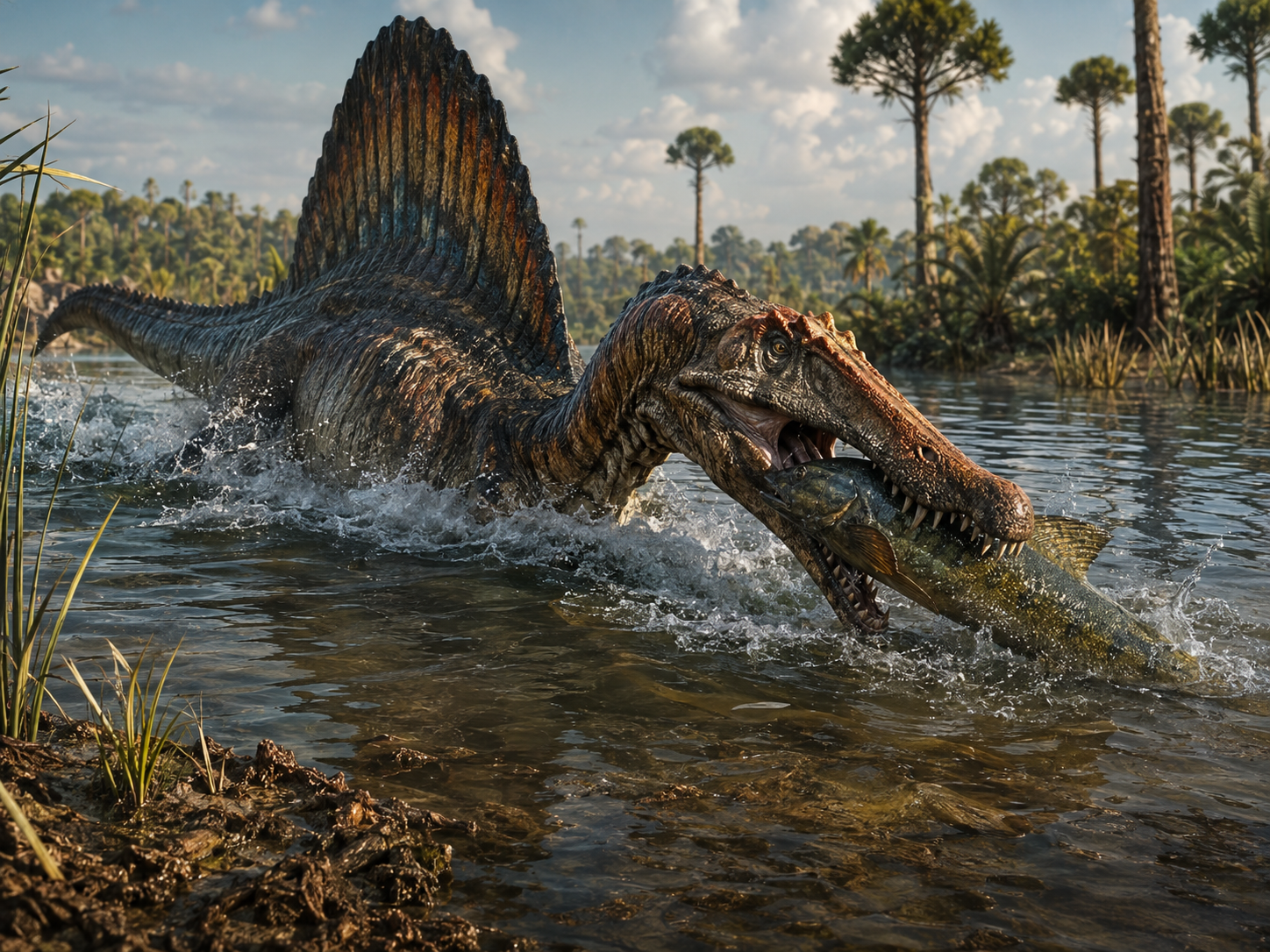
At roughly 14 m, Spinosaurus is the longest theropod in ScaleCheck's current comparison. Its narrow snout, dense bones, paddle-like tail and tall sail belong to an animal adapted to river systems.
Length
about 14 m long
Height
sail rising above a low, long body
Mass
about 7.4 tonnes
When
Late Cretaceous - about 99-93.5 million years ago
Spinosaurus swimming through a Cretaceous river environment
All bars share one linear metre scale. Human height and animal body length use different orientations, noted on each detail page.
Interactive true-scale view
Spinosaurus beside a 1.7 m human
The shared ground plane keeps 14 m and the human reference on one metre scale. Detailed models load progressively; labeled wireframes preserve scale where a model is pending.
Preparing the true-scale scene...
Drag to orbit · Scroll to zoom
Spinosaurus14 mDetailed 3D model
Human1.7 mDetailed 3D model
Full 3D exhibit Continue into the ranked gallery to inspect the model, camera angles and surrounding giants.
Fourteen metres is about 8.2 reference-human heights laid end to end. Even a city bus would be shorter than the reconstructed animal.
More than one number
Length, height and body mass
Spinosaurus gained length through an unusually long skull, torso and tail, not the blocky build of T. rex. That is why it can be longer while carrying less mass.
Display length
14 m
Display height
5.4 m
Display mass
7.4 t
Evidence boundary
How certain is this size?
The first important fossils were destroyed in 1944, and later discoveries repeatedly changed the reconstruction. Length and locomotion remain active research topics.
Why compare it
The question this animal answers
Its proportions make Spinosaurus a useful warning against one-number comparisons: a long animal is not automatically the heaviest or most powerful.