Giganotosaurus was one of South America's largest predators. A representative reconstruction reaches about 13 m, putting it close to T. rex in length but with a different, lighter-built skull and body.
Length
about 13 m long
Height
about 4 m at the hips
Mass
about 7.2 tonnes
When
Late Cretaceous - about 100-95 million years ago
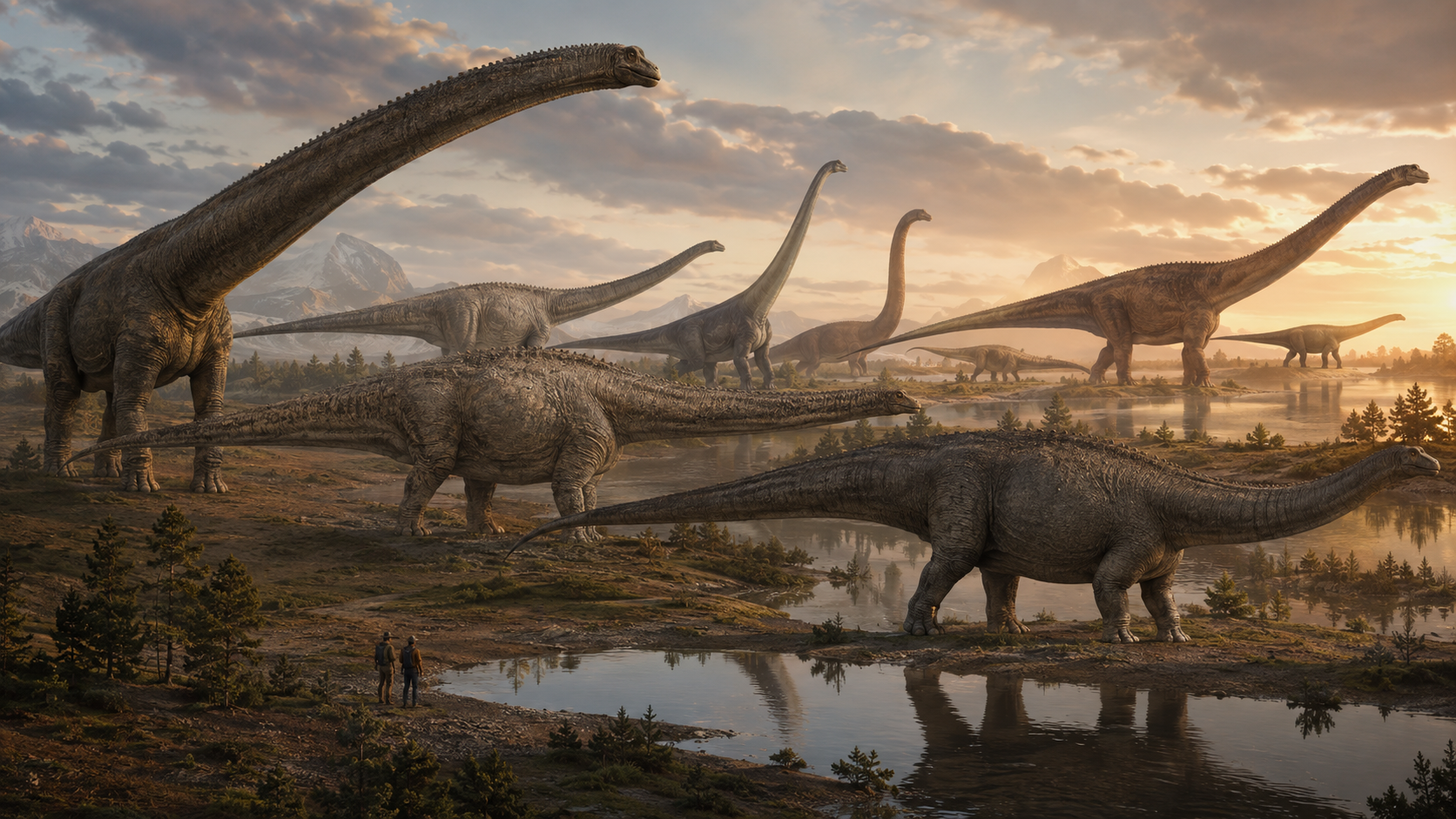
Giant dinosaurs restored in a prehistoric landscape
All bars share one linear metre scale. Human height and animal body length use different orientations, noted on each detail page.
Interactive true-scale view
Giganotosaurus beside a 1.7 m human
The shared ground plane keeps 13 m and the human reference on one metre scale. Detailed models load progressively; labeled wireframes preserve scale where a model is pending.
Preparing the true-scale scene...
Drag to orbit · Scroll to zoom
Giganotosaurus13 mTrue-scale proxy
Human1.7 mDetailed 3D model
Wireframe subjects mark exact display dimensions where a detailed GLB is not yet available.
Human scale
What 13 metres feels like
Thirteen metres equals about 7.6 reference-human heights. Its hip line would sit around the height of a single-storey roof.
More than one number
Length, height and body mass
It may have been slightly longer than many T. rex specimens, while estimates around 7.2 tonnes make it lighter than the largest tyrannosaurs.
Display length
13 m
Display height
4 m
Display mass
7.2 t
Evidence boundary
How certain is this size?
No complete skeleton is known. Missing portions must be reconstructed from related carcharodontosaurids, so both length and mass should be read as representative estimates.
Why compare it
The question this animal answers
Giganotosaurus separates cinematic reputation from anatomy: it is a close length rival to T. rex, but the fossil record does not support a simple winner in every dimension.