SIZE NOTE · From sauropods to pachycephalosaurs · nine group champions
Spinosaurus: The Longest Carnivorous Dinosaur and Secret of the Swimming Giant Dinosaur
Explore the true size of Spinosaurus (approx. 14 m), the dramatic history of its shifting reconstructions, comparisons with T-rex, and its unique semiaquatic lifestyle.

Quick Answer
The champion holding the title for the longest carnivorous dinosaur in Earth's history is Spinosaurus (Spinosaurus aegyptiacus).
Adults are estimated to have reached a representative length of about 14 m (46 ft) and a body mass of approximately 7.4 tons.
Compared to the world's most famous predator, Tyrannosaurus rex (approx. 12–12.5 m, 8.4 tons), Spinosaurus was more than 1.5 meters longer. However, T. rex had a much more robust and heavily built skeleton, outweighing Spinosaurus by about a full ton. In short, while Spinosaurus is 'the longest carnivorous dinosaur in Earth's history', the title of the heaviest carnivorous dinosaur belongs to Tyrannosaurus.
Furthermore, equipped with a massive 1.8-meter sail on its back, a long crocodile-like snout, and a recently discovered paddle-shaped tail fin, Spinosaurus was a singular giant adapted to a semiaquatic lifestyle unprecedented among large theropods.
Size Comparison
Numbers alone make it difficult to visualize the true scale of a 14-meter animal. Placing Spinosaurus side by side with humans, modern vehicles, and rival carnivorous dinosaurs offers a much clearer perspective.
| Subject | Representative Size / Weight | Compared to Spinosaurus (14 m) |
|---|---|---|
| Adult Human | Height 1.7 m / 70 kg | About 1/8 the length of Spinosaurus |
| City Transit Bus | Length approx. 11 m | Spinosaurus is longer than a standard bus |
| Spinosaurus | Length approx. 14.0 m / approx. 7.4 tons | Baseline (Longest theropod dinosaur) |
| Tyrannosaurus rex | Length approx. 12.5 m / approx. 8.4 tons | Shorter in length, but heavier in body mass |
| Giganotosaurus | Length approx. 12.5–13 m / approx. 7–8 tons | Slightly shorter in total body length |
A Dramatic History of Shifting Reconstructions
Few dinosaurs in paleontological history have undergone as radical a transformation in appearance and lifestyle as Spinosaurus.
-
[The Tragic Loss of the Holotype (1912–1944)]
In 1912, German paleontologist Ernst Stromer excavated the first known Spinosaurus fossils in the Bahariya Oasis of Egypt. Tragically, this irreplaceable holotype specimen was completely destroyed in 1944 during an Allied bombing raid on Munich in World War II. For decades, researchers were forced to rely solely on Stromer's surviving sketches and notes, leaving the dinosaur shrouded in mystery. -
[The Classic Bipedal Behemoth (Early 2000s)]
During this era, Spinosaurus was reconstructed primarily as a giant bipedal theropod resembling a T. rex with an elongated snout and a dorsal sail. The ferocious predator that famously defeated T. rex on screen in Jurassic Park III (2001) was modeled on the scientific understanding of this period. -
[Transformation into a Semiaquatic River Monster (2014–2020)]
In 2014, a research team led by Dr. Nizar Ibrahim unveiled a breakthrough partial skeleton from the Kem Kem Beds of Morocco. The discovery revealed surprisingly short hindlimbs and dense, compact bones—adaptations specialized for swimming and diving.
Then, in 2020, an exceptionally preserved tail fossil provided the definitive clue. The tall neural spines along its tail formed a broad, flattened paddle-like fin, resembling that of a newt or crocodile.
Weapons of the Cretaceous River Hunter
Spinosaurus occupied an ecological niche entirely distinct from other apex terrestrial carnivores.
 Morphological features and anatomy of Spinosaurus
- [Crocodilian Snout and Conical Teeth]
While T. rex possessed stout, banana-shaped teeth designed to crush bone, Spinosaurus had straight, smooth, conical teeth optimized for impaling and gripping slippery fish. Pressure-sensitive neurovascular openings at the tip of its snout allowed it to detect subtle water movements caused by swimming prey. - [The Enormous Dorsal Sail]
The towering sail rising up to 1.8 meters along its back may have served multiple functions, including thermoregulation, display during mating competitions, or hydrodynamic stabilization in the water. - [Paddle-like Tail and High-Density Bones]
Its laterally compressed tail provided powerful aquatic propulsion, while its dense skeletal structure—similar to that of penguins and hippos—helped counteract buoyancy for diving. Giant coelacanths (Mawsonia) and massive sawfish (Onchopristis) were among its primary prey.
Spinosaurus vs. T-rex: What Would Really Happen?
 Size comparison between Spinosaurus, Tyrannosaurus rex, and an adult human
While this clash remains a favorite topic of pop culture, the two titans never crossed paths in the fossil record.
Size comparison between Spinosaurus, Tyrannosaurus rex, and an adult human
While this clash remains a favorite topic of pop culture, the two titans never crossed paths in the fossil record.
- [A Vast Divide in Time and Geography]
Spinosaurus thrived roughly 99 to 93.5 million years ago (Cenomanian stage of the Cretaceous) in the river deltas of North Africa. Tyrannosaurus rex lived roughly 68 to 66 million years ago (Maastrichtian stage) in the terrestrial forests and floodplains of North America. They were separated by roughly 30 million years and thousands of miles. - [Different Builds for Different Worlds]
On land, Tyrannosaurus held an overwhelming advantage with its 8.4-ton mass and the most powerful bite force among terrestrial animals (estimated at 30,000 to 60,000 newtons). In deep rivers or wetlands, however, Spinosaurus held the upper hand with its specialized aquatic agility. Each was an apex predator perfected for its own ecological domain.
Standing Side by Side with Champions of Every Dinosaur Group
Spinosaurus stands as the undisputed champion of the Spinosauridae (Spinosauridae) family and the longest theropod ever discovered.
Beyond Spinosaurus, each major dinosaur lineage gave rise to its own astonishing giants. In ScaleCheck's [The Largest Dinosaur of Each Major Group] 3D exhibition, you can explore Spinosaurus alongside the champions of nine distinct dinosaur groups, all reconstructed at true fossil-derived scales:
- #1 Argentinosaurus (Sauropoda): 35 m / 75 tons — The colossal titan of terrestrial history
- #2 Shantungosaurus (Ornithopoda): 15 m / 13 tons — The largest duck-billed giant
- #3 Tyrannosaurus (Tyrannosauridae): 12.5 m / 8.4 tons — The ultimate apex predator with bone-crushing bite force
- #4 Triceratops (Ceratopsia): 8.5 m / 8 tons — The heavily armored horned champion
- #5 Spinosaurus (Spinosauridae): 14 m / 7.4 tons — The longest river-dwelling aquatic predator
- #6 Deinocheirus (Ornithomimosauria): 11 m / 6.4 tons — The bizarre hump-backed ostrich dinosaur
- #7 Therizinosaurus (Therizinosauria): 9.5 m / 5 tons — The feathered giant armed with 1-meter scythe claws
- #8 Stegosaurus (Stegosauria): 7 m / 3.8 tons — The plated guardian with a deadly thagomizer tail
- #9 Pachycephalosaurus (Pachycephalosauria): 4.5 m / 410 kg — The head-butting master with a 25 cm thick skull dome
Experience how the 14-meter length and prominent sail of Spinosaurus compare directly with a 35-meter sauropod or a 12.5-meter T. rex by freely adjusting the camera perspective in the ScaleCheck 3D scene.
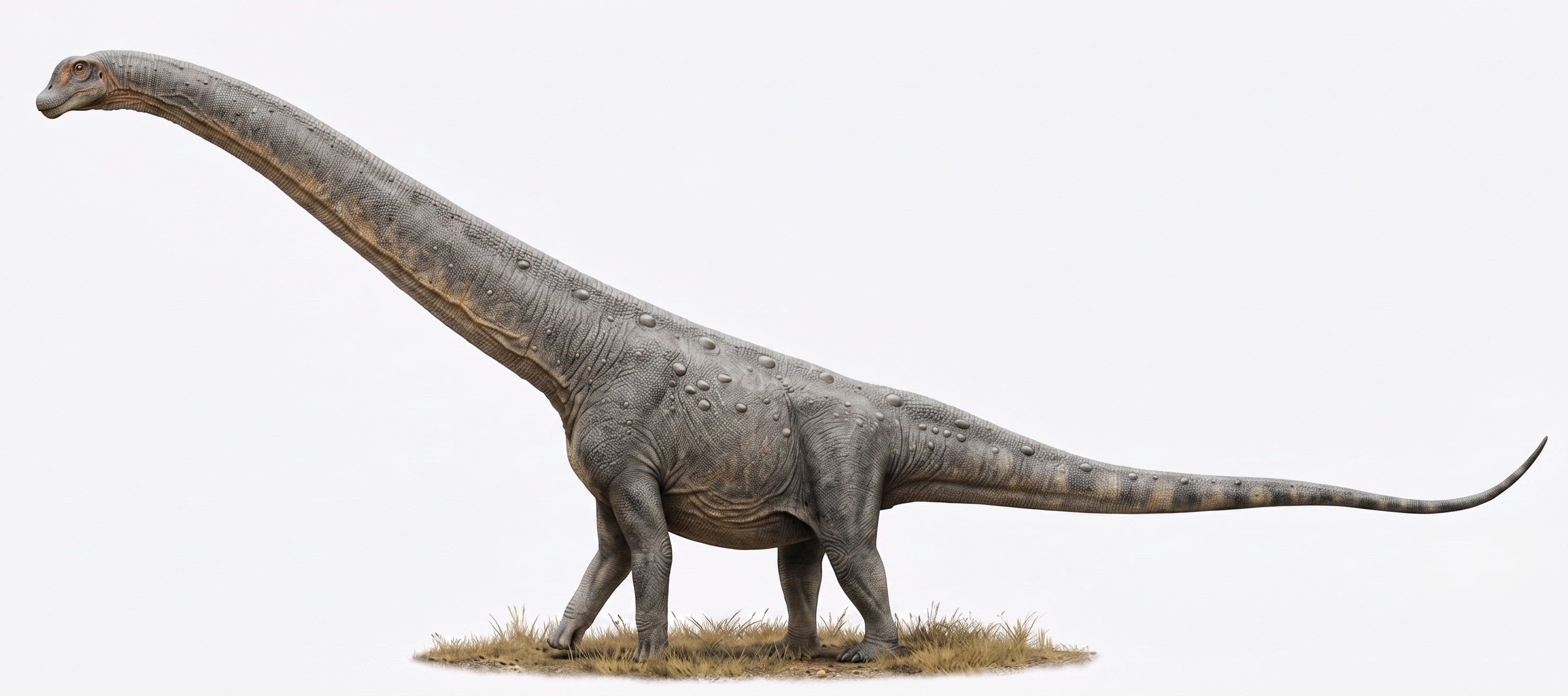
RELATED 3D EXHIBIT · 006
See it at true scale.
Explore The Largest Dinosaur of Each Major Group to place this subject beside others at true scale.
Enter exhibitSOURCES
Sources

Top 10 Largest Dinosaurs in History: Which Was the Biggest?
Compare the sizes and features of the 10 largest dinosaurs in history based on estimated body mass derived from fossils.
Read story
Megalodon vs. Mosasaurus: Which Was Bigger?
Compares Megalodon and Mosasaurus size estimates, explains why Mosasaurus keeps shrinking across studies, and details the 43-million-year gap between them.
Read story