SIZE NOTE · Giant Marine Animals · TOP 9
Megalodon vs. Mosasaurus: Which Was Bigger?
Compares Megalodon and Mosasaurus size estimates, explains why Mosasaurus keeps shrinking across studies, and details the 43-million-year gap between them.

Quick Answer
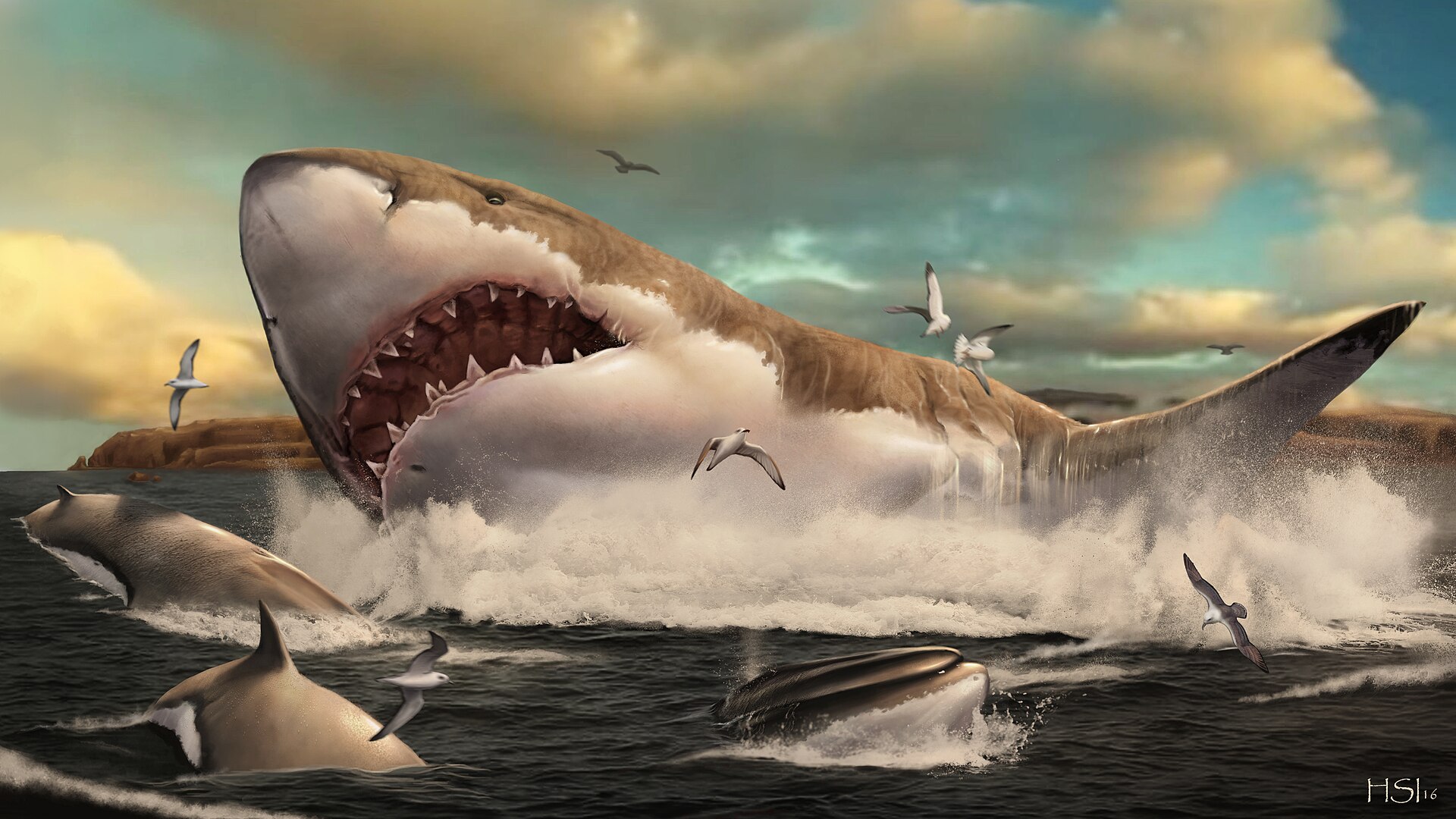 Life restoration of a Megalodon rising to the surface
Megalodon was bigger, and the difference is wider than commonly known.
Megalodon is conservatively estimated at 15 to 18 m, and a 2025 reassessment suggested a possible maximum of about 24.3 m.
Mosasaurus, once reconstructed at 17 m, has been revised down to 12–13 m in recent studies.
Furthermore, the two animals never met. Mosasaurus disappeared 66 million years ago, and Megalodon appeared roughly 43 million years later.
Size Comparison
| Subject | Estimated Size | Basis / Evidence |
|---|---|---|
| Megalodon conservative estimate | Approx. 15–18 m | Proportional estimation from tooth and vertebra fossils |
| Megalodon 2025 upper-bound hypothesis | Up to approx. 24.3 m | 2025 body reconstruction study |
| Mosasaurus current estimate | Approx. 12–13 m | 1:7 skull-to-body length ratio applied to the largest jawbone |
| Mosasaurus past estimate | Approx. 17 m | 1:10 ratio used in mid-20th-century reconstructions |
Why Does Mosasaurus Body Length Keep Shrinking?
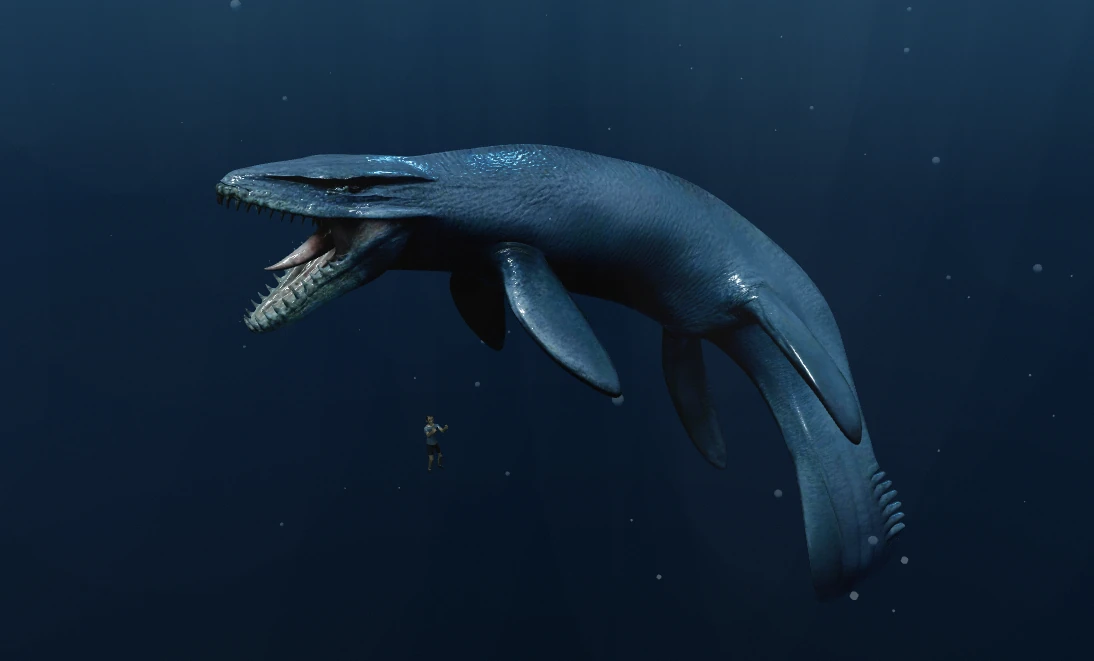
 Illustration comparing size estimates of several Mosasaurus specimens with a diver
The jawbone of the largest known Mosasaurus hoffmannii discovered to date belongs to the Penza specimen from Russia, measuring about 171 cm in length.
Illustration comparing size estimates of several Mosasaurus specimens with a diver
The jawbone of the largest known Mosasaurus hoffmannii discovered to date belongs to the Penza specimen from Russia, measuring about 171 cm in length.
To derive total body length from this jawbone, one assumption must be made: how many times the length of the skull was the entire body?
Reconstructions from the 1960s used a ratio close to 1:10, yielding a body length of about 17 m.
Subsequent studies analyzing more complete mosasaur skeletons showed that the head was proportionally larger relative to the body—closer to a 1:7 ratio—recalculating the same jawbone to about 12 m.
It was not because new fossils were excavated. The fossil remained the same; only the multiplier changed.
Megalodon's Numbers Move Too — Only Upward
 Life restoration comparing the size of Megalodon and a human diver
Megalodon faces the same problem from the opposite direction.
Life restoration comparing the size of Megalodon and a human diver
Megalodon faces the same problem from the opposite direction.
A shark's skeleton is mostly cartilage, leaving behind only teeth up to 18 cm tall and rarely discovered vertebrae.
In 2025, Kenshu Shimada and 28 co-researchers compared the vertebral proportions of 165 shark species and proposed a longer, sleeker body instead of a stocky build resembling a scaled-up great white shark.
According to this reconstruction, the largest known vertebra would belong to an individual measuring about 24.3 m.
Even by a conservative 16 m baseline, its body weight reaches about 60 tons, nearly six times the estimated weight of a large Mosasaurus (approx. 10 tons).
Mosasaurus Is Not a Dinosaur
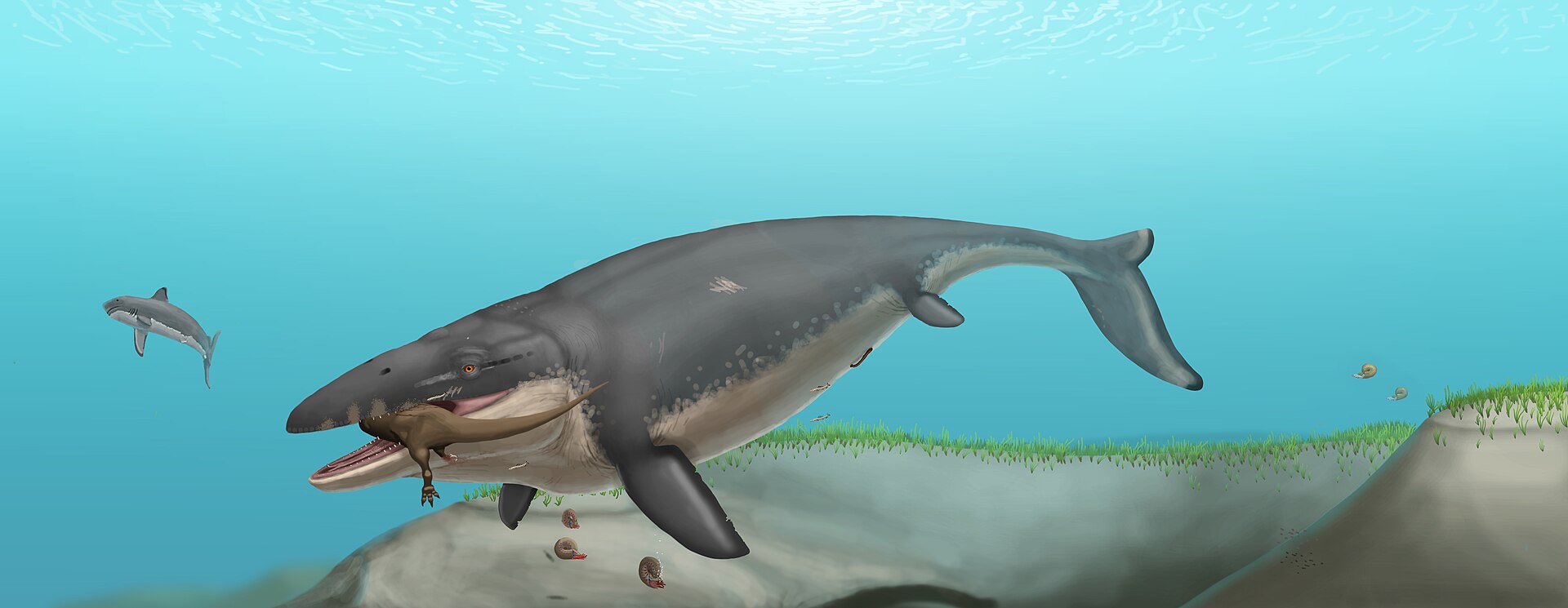 Mosasaurus hunting a sea turtle in a shallow Cretaceous sea
Mosasaurus was not a dinosaur, but a lizard adapted to the sea. Its closest living relatives are monitor lizards and snakes.
Mosasaurus hunting a sea turtle in a shallow Cretaceous sea
Mosasaurus was not a dinosaur, but a lizard adapted to the sea. Its closest living relatives are monitor lizards and snakes.
Although it spent the Late Cretaceous alongside dinosaurs and vanished in the same mass extinction, it belongs to an entirely different evolutionary branch.
Its body structure reflects that lineage: four paddle-like limbs, a downward-bent tail forming a fluke, and a second row of teeth on the palate—the pterygoid teeth—that trapped struggling prey to prevent escape.
On the other hand, Megalodon was a shark built around a single weapon: serrated triangular teeth and an estimated bite force exceeding 100,000 newtons.
The 43-Million-Year Gap
 Fossil skull of a juvenile Mosasaurus displayed in a museum
Mosasaurus ruled the oceans from about 82 million to 66 million years ago, vanishing with the asteroid impact that ended the Cretaceous.
Fossil skull of a juvenile Mosasaurus displayed in a museum
Mosasaurus ruled the oceans from about 82 million to 66 million years ago, vanishing with the asteroid impact that ended the Cretaceous.
Megalodon appeared about 23 million years ago and survived until 3.6 million years ago. Whales, which evolved to fill the oceans vacated by marine reptiles, were its prey.
There is a gap of about 43 million years between them—more than ten times the amount of time that has passed since Megalodon went extinct.
A fight was impossible from the start, and the sizes we compare are results drawn from two fossil records of completely different natures.
In the ScaleCheck exhibition, you can place both animals in the same space and observe their differences at true scale.
RELATED 3D EXHIBIT · 001
See it at true scale.
Explore Largest Marine Animals in History to place this subject beside others at true scale.
Enter exhibitSOURCES
Sources
- Palaeontologia Electronica — Reassessment of the size and form of Otodus megalodon (2025)
- Natural History Museum — What is a mosasaur?
- Smithsonian Ocean — Megalodon
- Image: Otodus megalodon restoration by Hugo Saláis (CC BY 4.0, Wikimedia Commons)
- Image: Mosasaurus hoffmanni life restoration by Jonagold2000 (CC BY-SA 4.0, Wikimedia Commons)

Megalodon vs. Blue Whale: Which Was Actually Larger?
Compares fossil estimates of Megalodon's length with actual blue whale records, explaining why figures vary across studies.
Read story
Top 10 Largest Dinosaurs in History: Which Was the Biggest?
Compare the sizes and features of the 10 largest dinosaurs in history based on estimated body mass derived from fossils.
Read story