SIZE NOTE · Giant Marine Animals · TOP 9
Giant Squid vs Colossal Squid: Why Longer Doesn't Mean Heavier
Compare giant and colossal squid through measured size, a 495 kg specimen, feeding tentacles and huge eyes. Discover the deep-sea story behind their bodies.

Lead illustration: A. E. Verrill, 1882 / Wikimedia Commons, public domain. This is a historical scientific drawing, not a photograph.
Imagine a squid as long as a bus. It is tempting to give it a bus-sized body, then attach the arms. Finding out where the tape measure ends changes that picture.
Giant squid stand out for length; colossal squid stand out for mass. Smithsonian gives a recorded giant squid total length of about 13 m. A famous colossal squid specimen held by New Zealand's Te Papa museum was reported at 495 kg. These are different animals, with different proportions.
What is included in a 13 m squid?
A giant squid has eight arms and two long feeding tentacles. In the drawing above, the two especially elongated appendages are those tentacles. Total length reaches all the way to their tips.
Tentacles can stretch or be lost. Smithsonian's account explains why researchers also use mantle length—the length of the main body enclosing the organs—to compare size.
“Thirteen-meter squid” is a memorable phrase. It leaves out the part that tells you how much of that length is body.
Giant squid and colossal squid compared
| Feature | Giant squid | Colossal squid |
|---|---|---|
| Scientific name | Architeuthis dux | Mesonychoteuthis hamiltoni |
| Length | A recorded total of about 13 m includes tentacles | Can be shorter while having a bulkier body |
| Mass | Te Papa's comparison gives up to about 275 kg | A well-known specimen recovered in 2007 was reported at 495 kg |
| Distinctive anatomy | Very long feeding tentacles | Heavy mantle and swivelling tentacle hooks |
These figures come from different specimens and references. They are not measurements of two average adults, and the longest and heaviest records should not be combined into an imaginary individual.
Te Papa's comparison explains the contrast in body shape. Some museum guidance describes the displayed specimen as 490 kg; the 495 kg figure used here appears in its 2014 examination report and a 2017 scientific review. A specimen record is not a proven upper limit for the species.
Where the weight sits
 A preserved colossal squid at Te Papa, with broad fins, a substantial mantle and arms extending down the display tank.
Photo: Oren Rozen / Wikimedia Commons, CC BY-SA 3.0. Resized proportionally and compressed to WebP; this image remains under the same license.
Compare this preserved animal with the drawing above. Extra reach at the end of a slender tentacle and extra volume in the mantle are very different ways to be big.
Te Papa describes its exhibited colossal squid's mantle as roughly 2.5 m long and 98 cm wide in its body-parts account. Those dimensions give the mass somewhere to sit in your mental picture.
Preservation matters too. The hanging arms and color in a display tank should not be treated as an exact portrait of a living squid swimming.
What are the hooks for?
Colossal squid have swivelling hooks on their tentacle clubs. An actual encounter explains their usefulness better than a sea-monster scene.
Te Papa's displayed animal came up on a toothfish longline, still attached to a fish it had been eating. The museum also describes squid damage on caught toothfish. Adult toothfish can reach 2 m, giving the squid substantial prey to hold. These observations appear in Te Papa's feeding account.
The hooks help make sense of that relationship. A detailed sequence of underwater hunting movements is harder to establish: reconstructions based on anatomy and related squid should be identified as inference.
Huge eyes, and something bigger to watch for
Dark water still contains light produced by living organisms. Large eyes and pupils can help collect faint signals. Te Papa's eye guide connects colossal squid vision with life in that environment.
A more specific proposal brings sperm whales into the story. A 2012 study by Nilsson and colleagues modeled how enormous eyes might help detect approaching whales, including light from bioluminescent organisms disturbed by their movement.
That is an evolutionary hypothesis supported by a visual model, not a filmed encounter proving why the eyes evolved. It nevertheless changes the scene: the giant animal needs to watch for something that can eat it.
Does deep water make everything gigantic?
There is no simple rule that high pressure produces huge animals. Feeding, growth, movement and predation all matter when investigating body size.
A 2017 review by Rosa and colleagues emphasizes how much remains unknown about colossal squid biology. Young and older animals use different depths, and the available specimens leave large gaps in their life history.
We can explain why a substantial mantle contributes more mass than elongated tentacles. Explaining why a species evolved that body is a further question, with less certain answers. Anatomy gives us evidence without supplying a complete evolutionary story.
A jar can tell us more than a monster scene
 Preserved giant squid tissue and an old specimen label at Copenhagen's Zoological Museum, with part of a tentacle model behind the jar.
Photo: Inger E Winkelmann / Wikimedia Commons, CC BY-SA 4.0. Resized proportionally and compressed to WebP; this image remains under the same license.
This photograph shows preserved material rather than a complete giant. Its label is part of the evidence too: it records a history of collecting and classification. The large tentacle model behind the jar should not be confused with the preserved tissue.
Stories tend to give us the whole creature. Research often has to begin with a piece of one. That is why specimen condition and measurement method deserve space beside the spectacular number.
Which is the world's biggest squid?
Start with giant squid for length and colossal squid for recorded mass. Then check whether a quoted maximum was measured from a specimen or estimated.
Does their size prove stories of ship-attacking krakens?
No. Large bodies and hooked tentacles establish anatomical facts. They do not, by themselves, substantiate stories about attacks on ships.
Our blue whale size story offers another way to think about length and bulk. When exploring the marine animals exhibit, remember that the tip of a squid's feeding tentacle and the end of a whale's body do not tell you the same thing about how much animal is there.
The lead image is a public-domain scan of A. E. Verrill's 1882 work, restored by Wikimedia Commons contributor Citron. It and both photographs were resized without cropping and compressed for the web.
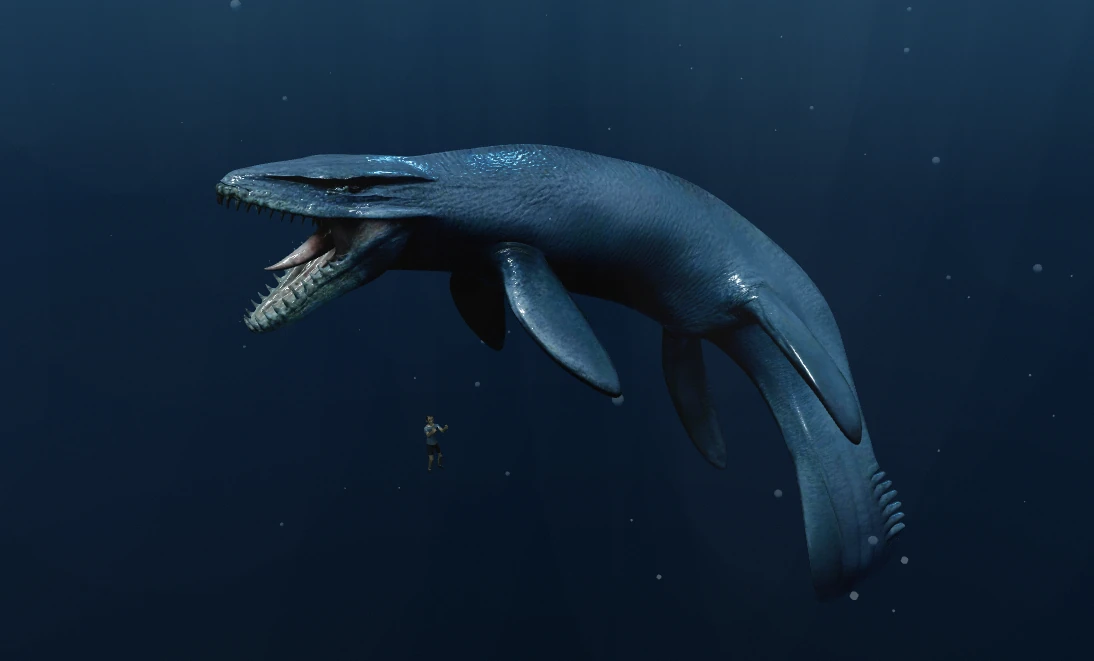
RELATED 3D EXHIBIT · 001
See it at true scale.
Explore Largest Marine Animals in History to place this subject beside others at true scale.
Enter exhibitSOURCES
Sources
- Smithsonian Ocean — Giant Squid: measured length and tentacles
- Te Papa — Colossal squid, giant squid, and octopus
- Te Papa — Colossal Squid: What did we find? (2014)
- Te Papa — Colossal squid: the body parts
- Te Papa — How the colossal squid feeds
- Rosa et al. (2017) — Biology and ecology of the world's largest invertebrate
- Nilsson et al. (2012) — A Unique Advantage for Giant Eyes in Giant Squid
- Te Papa — The eyes of the colossal squid

The Largest Creature on Earth: The Blue Whale
Introducing the overwhelming size and characteristics of the blue whale, the largest creature on Earth, for an intuitive understanding at a glance.
Read story


Megalodon vs. Mosasaurus: Which Was Bigger?
Compares Megalodon and Mosasaurus size estimates, explains why Mosasaurus keeps shrinking across studies, and details the 43-million-year gap between them.
Read story