SIZE NOTE · Our Solar System · TOP 10
Why Are Saturn's Rings So Thin? Inside a 280,000 km Disk
Saturn's rings span about 280,000 km, yet its main rings are typically only about 10 m thick. Explore the ice, collisions and tiny moons behind the contrast.

Lead image: NASA/JPL-Caltech/Space Science Institute, PIA14943.
Draw Saturn and the big oval usually comes first. Now turn that oval sideways. You might expect to see the edge of a thick plate. The real rings nearly vanish into a line.
Measured across the F ring, the system spans roughly 280,000 km. The bright main rings have a typical thickness of only about 10 m. An enormous horizontal reach and a modest building height belong to the same structure. Even stranger, nothing underneath holds it up.
A ring you could never stand on
The smooth band breaks down into individual objects when you look closely. Water ice dominates the rings, and the pieces orbit Saturn separately. There is no continuous frozen floor beneath them. NASA's Cassini ring overview describes a vast population of ice particles of different sizes.
Look again at the lead photograph. Its pale and dark bands are more interesting once you stop picturing painted stripes. The distribution of particles and the way light passes through them affect what we see. Cassini even watched distant starlight pass through the rings to investigate their structure.
A surface that looks continuous from far away can turn out to be mostly a question of where you are standing.
What does “280,000 km wide” actually measure?
Ring measurements are easy to mix up. A distance from Saturn's center is a radius. A measurement from one side of the system to the other is a diameter. Including the faint outer rings changes the question again.
| Measurement | Value used here | What it means |
|---|---|---|
| Saturn's center to the outer F ring | About 140,270 km | A radius, not a distance above the cloud tops |
| F ring from side to side | About 280,540 km | Twice that radius, rounded to 280,000 km |
| Typical main-ring thickness | Around 10 m | Not a maximum height for every ring feature |
The F-ring distance comes from the Cassini FAQ. This span excludes diffuse structures farther out, such as the E ring.
Here is a scale exercise rather than another record: assume a sheet of paper is 0.1 mm thick. Reduce 280,000 km and 10 m by the same factor until the thickness matches that sheet. The disk would still be about 2.8 km across. A paper plate is far too chunky. You need something covering several neighborhoods.
That calculation deliberately uses rounded, representative dimensions. It does not mean every part of the rings is equally thin.
Why does the material settle into a disk?
Ring particles collide. Those collisions dissipate some of their motion, including movement above and below the ring plane, while the system retains its overall rotation. The combined effect helps produce a thin disk.
A study by Brilliantov and colleagues describes the roles of angular momentum and energy loss in particle collisions, alongside the repeated formation and breakup of clumps.
There is no moment when everything clicks into a perfectly still sheet. Particles continue interacting, and nearby moons disturb their paths. The orderly outline conceals continual small changes.
The little moon making waves
 Daphnis inside Saturn's Keeler Gap, beside rippled ring edges photographed by Cassini in January 2017.
Image: NASA/JPL-Caltech/Space Science Institute, PIA21056.
The small bright object in the dark gap is Daphnis. The rippled edge beside it is a gravitational disturbance, not an imaging mistake.
NASA describes an approximately 8 km moon traveling through the Keeler Gap in the A ring. Its gravity disturbs neighboring particles, producing waves both within the ring plane and vertically. Those raised features help explain why “about 10 m thick” should never be read as a universal height limit.
In a photograph dominated by immense arcs, the little lump is doing something visible to its surroundings. Follow the edges and gaps, and the rings start to look much less static.
Could the rings be pieces of broken moons?
Close to Saturn, the difference in gravity across a loosely bound object can interfere with its ability to remain together. This is the tidal problem described by the Roche limit.
The source of the original material is a separate question. Collision simulations reported by NASA in 2023 explored whether two icy moons could have supplied ring material when they collided. One challenge is explaining why so much ice, rather than rock, ended up in the rings.
A simulation tests a possible history. It is not an eyewitness account of the rings forming. Understanding their present structure does not automatically settle their origin.
Questions that come up at the telescope
Do the rings really disappear?
They can become extremely difficult to see when Earth views them edge-on. NASA's Hubble explanation describes this geometry occurring twice during Saturn's roughly 30-year orbit. Turn a sheet of paper to eye level and the effect becomes familiar. A viewing-angle change is different from material physically leaving the rings.
Is Saturn the only planet with rings?
Jupiter, Uranus and Neptune have rings too. Saturn's particularly conspicuous system makes it the planet most people associate with them.
Why do models show thicker rings?
At a scale where an entire planet fits on screen, a thickness of a few meters becomes difficult to display. Check which dimensions a model actually represents before using its visible edge as a measurement.
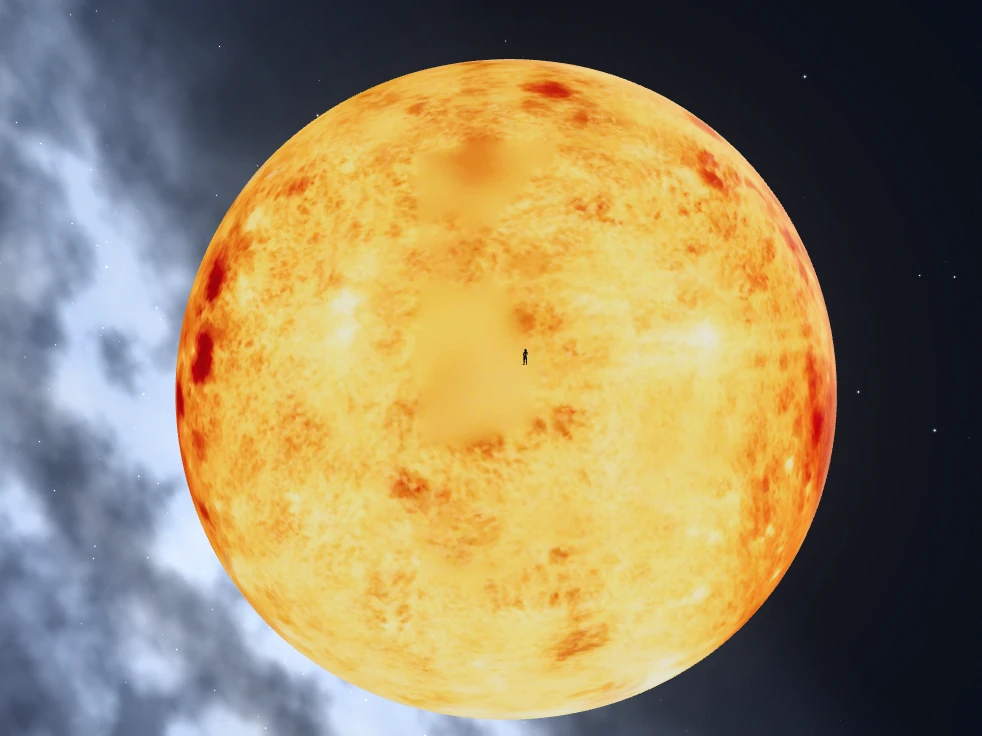
The distinction between measurements also comes up in our Sun and Earth size comparison. Compare planetary diameters in the solar system exhibit, then return to these photographs. Saturn's most recognizable feature stretches far beyond the planet while barely occupying the vertical dimension.
Both images were resized proportionally and compressed to WebP. NASA/JPL-Caltech/Space Science Institute imagery is used for scientific explanation under the JPL image use policy.
RELATED 3D EXHIBIT · 002
See it at true scale.
Explore Solar System Objects Size Comparison to place this subject beside others at true scale.
Enter exhibitSOURCES
Sources
- NASA Cassini — Rings: composition and thickness
- NASA Cassini FAQ — F-ring radius and the Roche limit
- Brilliantov et al. — Size distribution of particles in Saturn's rings from aggregation and fragmentation
- NASA — Daphnis Up Close, PIA21056
- NASA — Saturn's Rings Viewed from Earth
- NASA — New Simulations Shed Light on Origins of Saturn's Rings and Icy Moons
- NASA — Translucent Arcs, PIA14943

How Much Bigger Is the Sun Than Earth?
Explores the sizes of the Sun and Earth and compares their difference using balls.
Read story
The Largest Creature on Earth: The Blue Whale
Introducing the overwhelming size and characteristics of the blue whale, the largest creature on Earth, for an intuitive understanding at a glance.
Read story